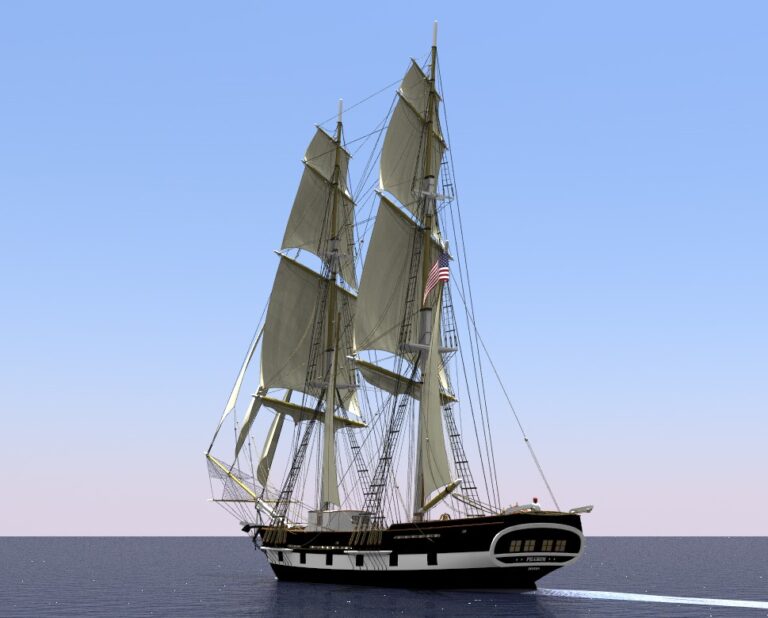
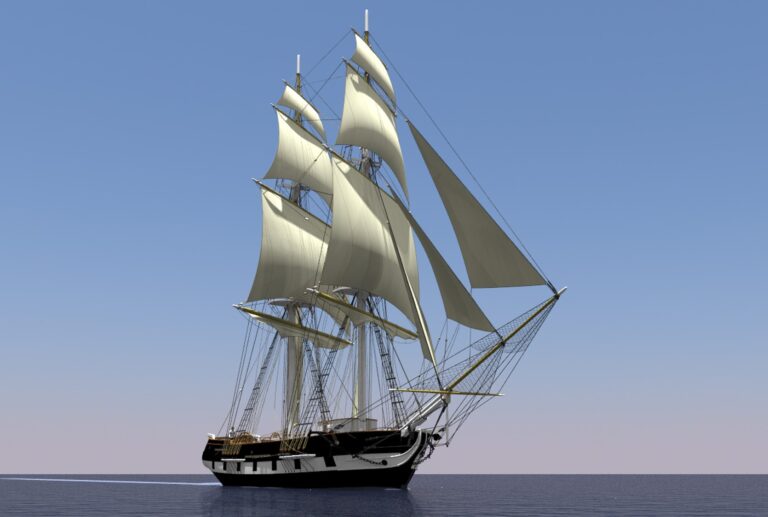
The Ship Design
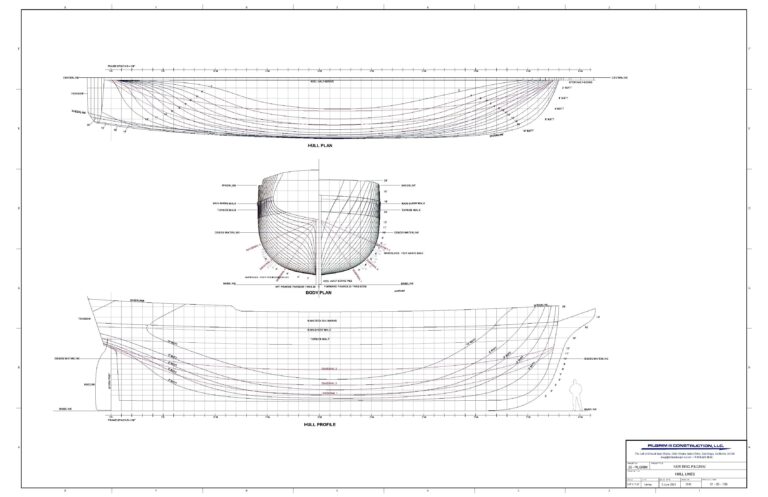
THE HULL LINES PLAN
Hull Length Overall ……………………………. 97′ 9″
Length on Deck ………………………………… 89′ 9-1/2″
Waterline Length ………………………………. 86′ 2-1/4″
Max Beam over Channels ……………………. 25′ 9-3/4″
Max Molded Hull Beam………………………… 23′ 6″
Max Waterline Beam …………………………. 22′ 11-3/4″
Design Draft ……………………………………… 10′ 0″
Displacement at Design Draft ……………… 231 L. tons
Disp/Length ratio ……………………………….. 361
Wetted Area at Design Draft ………………… 2428 sq ft
Block Coefficient ………………………………… 0.407
Prismatic Coefficient …………………………… 0.676
Waterplane Coefficient ………………………… 0.736
Midship Coefficient ……………………………… 0.602
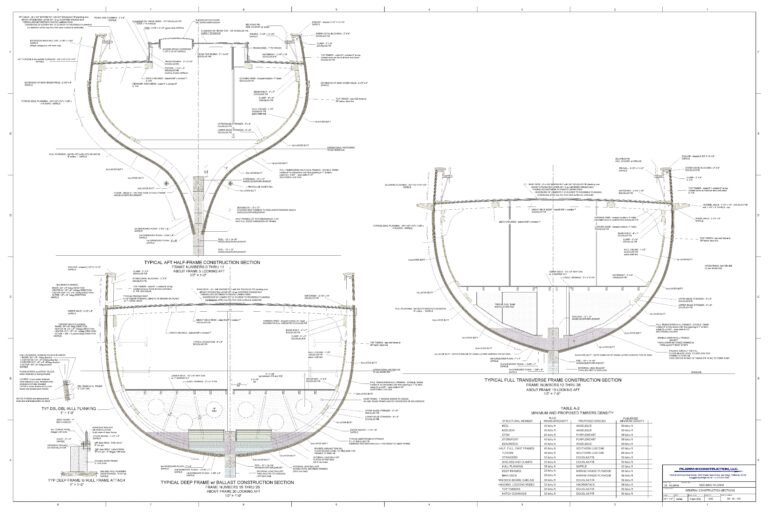
THE TYPICAL CONSTRUCTION SECTIONS
Southern Live Oak transverse sawn frames on 24″ frame spacing
Southern Live Oak transverse sawn half frames aft, sawn cant frames fwd
Purpleheart keel, keelson, deadwood, stern post, gripe and stem assembly
Douglas Fir sawn Top Timbers
Douglas Fir sawn transverse deck beams, longitudinal deck carlins, lodging/standing/hanging knees, hatch coamings
Sapele/Wana hull planking – longl inner 3/4″ layer, +/- 45 deg 1/2″ mid layers, longl outer 3/4″ layer .. at hull topside wales outer layer is 1-3/8″
Marine Grade Ply 2 x 3/4″ deck plating w/ 3/4″ D. Fir planking over
Ballast system: Lead external ballast pieces thru-bolted to keel (18.5 L. ton), Lead internal ballast pieces between frames to top of frame at center (20.8 L. ton) and internal Lead plate in FRP tubs above floor height (25.6 L. ton)
Marine Grade Ply watertight bulkheads on frame faces w/ D. Fir stiffeners
Marine Grade Ply deep frames – top of transverse frame to underside of belowdeck
Bilges filled with poured Asphalt Tar to top of keelson
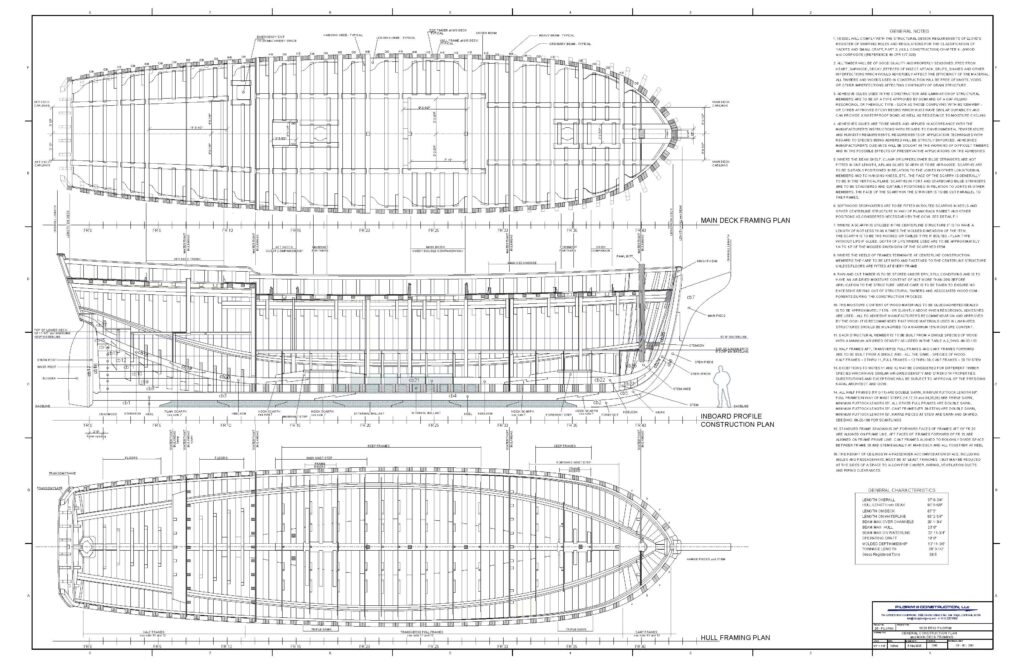
THE HULL and DECK FRAMING PLAN
The ship will be constructed and framed in much the same way as the original PILGRIM of 1825. New England shipbuilding in the early 19th century was based on an extension of the accumulated naval architecture and construction knowledge of the great shipbuilders – Spanish, Dutch, French and English – of the preceding centuries plus access to the abundant natural materials resources in the new world, with a good dose of Yankee entrepreneurialism thrown in for good measure. The hull and deck framing system adopted for PIII follows the traditional pattern: closely spaced transverse sawn hull frames on a stiff backbone structure, longitudinal stringers at the bilges and longitudinal deck shelves and clamps at the deck line to maintain framing alignment and contribute to hull sectional modulus stiffness. Completing the primary framing system; transverse deck beams with logitudinal carlins and a system of hanging/lodging/standing knees (brackets) for torsional stiffness. The materials chosen for each of the elements of the framing system match closely in characteristics of grain structure, weight, strength and stiffness as was used in the original PILGRIM – only sourced from further afield in acknowledgement of 200 years of consumption and taking advantage of strictly sustainable resources wherever possible.
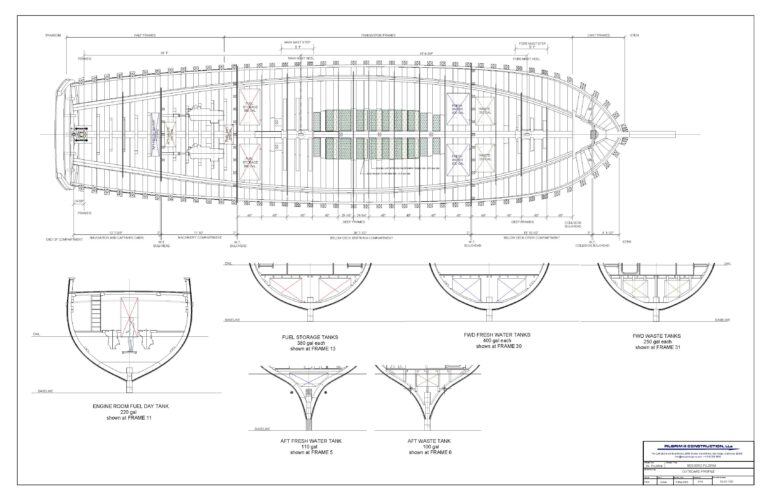
THE BILGE and TANKS ARRANGEMENTS
In the space below the lower deck – the area reserved for adjustable ballast and cargo in the original PILGRIM – PIII will locate service tanks for water fuel and waste, fixed internal ballast, deep frames for tonnage calculations, batteries (if an electric drive system is adopted) and various subsystem components. Main mast and foremast steps are also located in the underdeck spaces.
Water Tanks will be FRP – two tanks at total capacity of 800 gallons
Diesel Fuel Tanks will be steel – two tanks at total capacity of 760 gallons
Waste Tanks will be polyethylene – two tanks at total capacity of 500 gallons
And located in the Machinery Space aft:
Aft Water Tank will be FRP – 110 gallon capacity
Diesel Fuel Day Tank will be steel (on fwd bulkhead) – 220 gallon capacity
Aft Waste Tank will be polyethylene – 100 gallon capacity
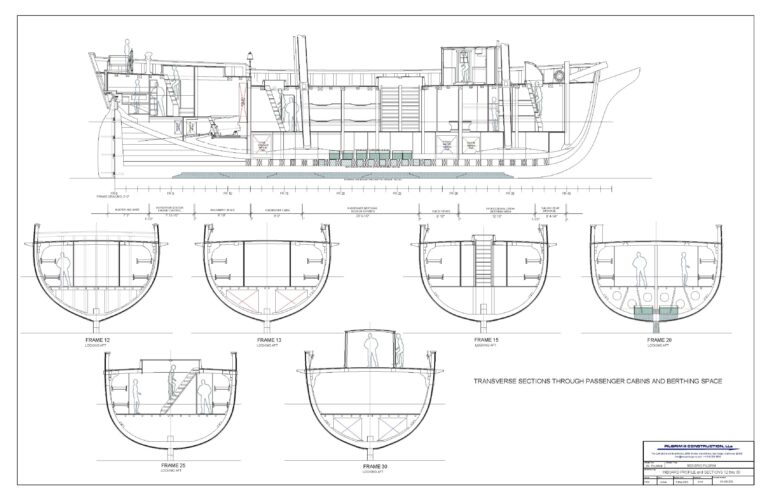
INBOARD JOINER PROFILE and ACCOMMODATIONS SPACES SECTIONS
The inboard profile shows the layout of the belowdeck accommodations spaces and the various ladder companionways for ingress/egress – each bulkhead-enclosed compartment will have minimum two means of escape.
The forward compartment – similar to the original – is accommodations for the professional mariners of the crew and educators.
The main compartment is for students, educational displays and exhibits and adventuring mariners in sail training programs.
Aft of the main compartment is the machinery space – where the main components of the ship’s working propulsion, electrical generation, auxiliary piping, electrical and safety systems are located. Not strictly following the traditional, but a nod to modern regulatory and operational requirements.
Following the machinery space aft on the starboard side is a command/control/navigation compartment, aft of which is accommodation space for the captain and first officer.
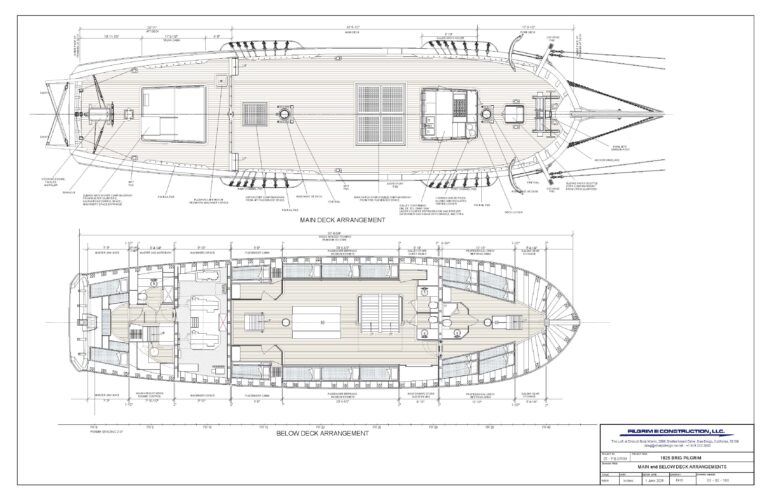
THE MAIN and BELOWDECK ARRANGEMENTS
The main deck, center of educational and adventuring activities, is laid out true to the original early 19th century trading brig arrangement – pump-handle horizontal windlass forward, foremast followed by on-deck galley house, large cargo hatch access to stoware hold, main mast before the break in deck height to aft deck with low trunk cabin and drum wheel to tiller steering. As these ships were designed to be handled by relatively small in number crew, all the sail handling functions are contained on the deck with belying stations at fife rails at the masts and pin rails along the sides.
The belowdeck arrangements as outlined above, are more a nod to modern convenience and regulatory requirements than adherence to strictly historical interpretation. Nonetheless, the arrangements are designed to provide a comfortable and safe educational and adventuring experience for professional crew, educators, students and guests alike. PIII sees nothing wrong with a bit of comfort after a hard day of marinering in the true early 19th century spirit.
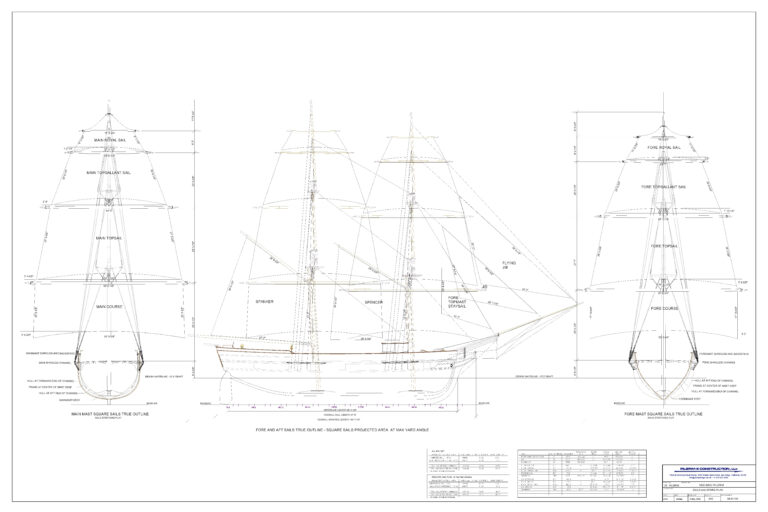
THE SAILPLAN and STABILITY
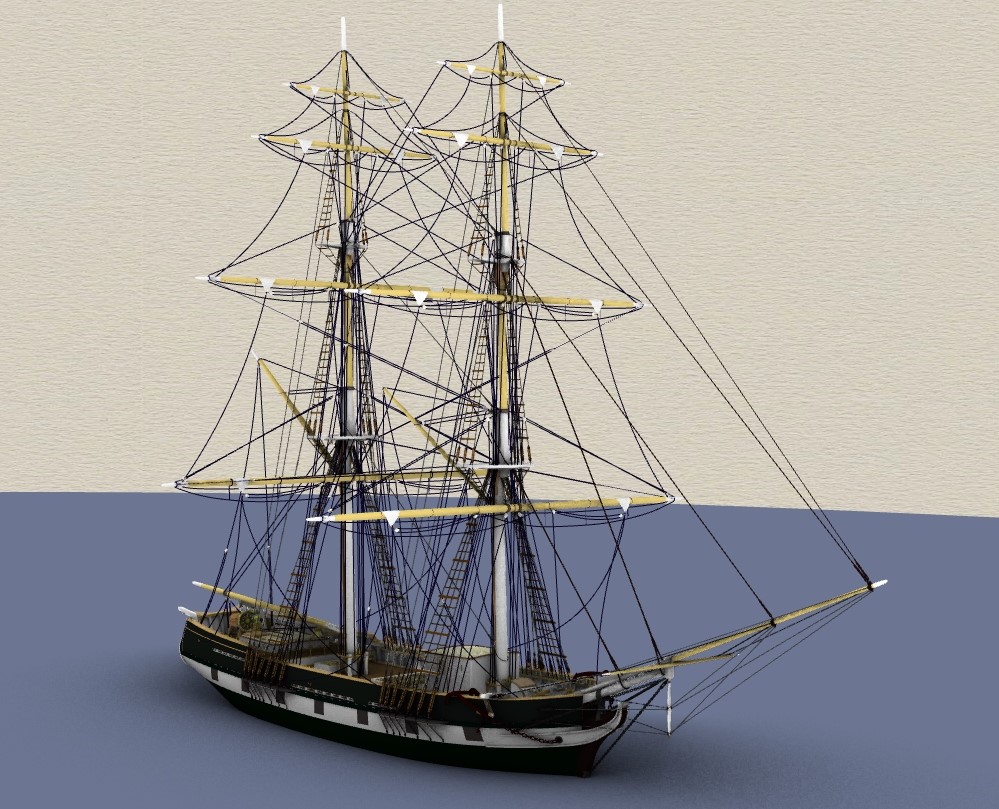
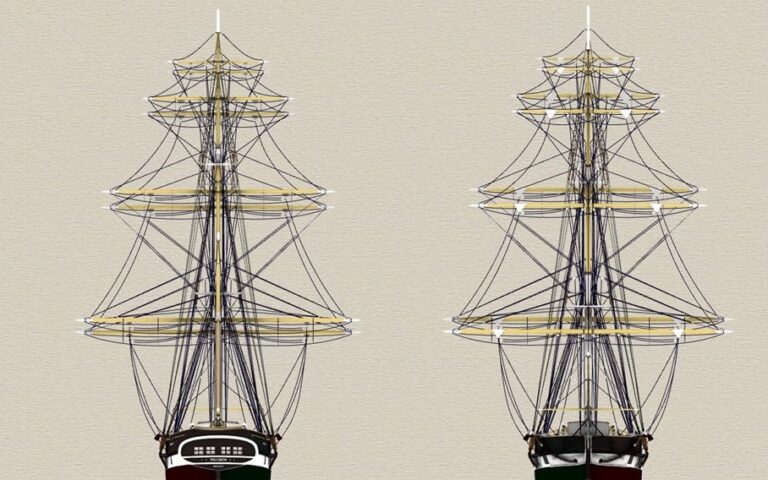
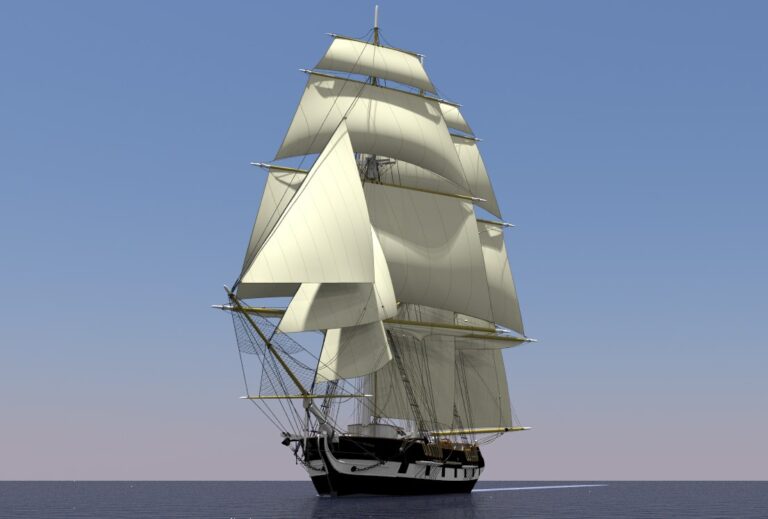
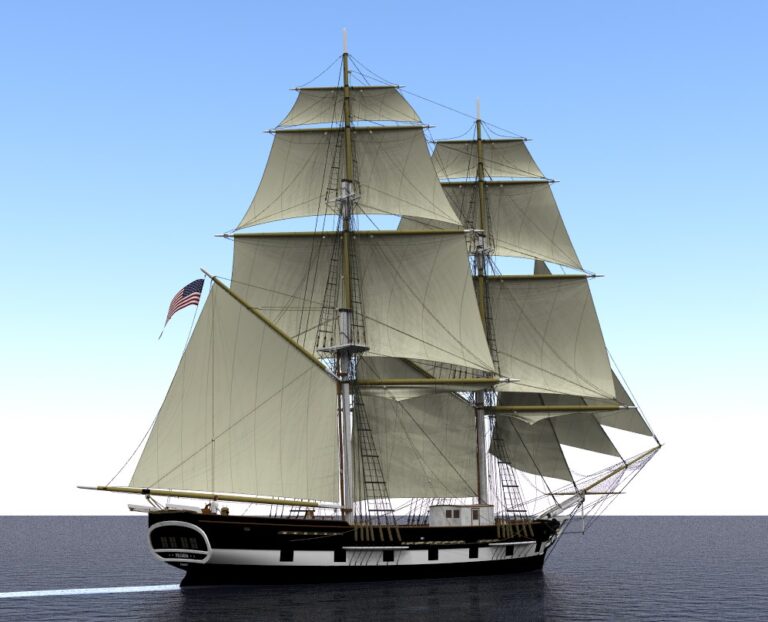
The PIII sailplan is of a typical small brig of the era of the original PILGRIM with all rig proportions true to the historical record. However, in the modern era PIII is bound to certain regulatory safety and stability requirements that will be met through the use of careful blending of the hull design with external and internal ballasting systems plus utilization of lighter, stiffer, stronger and longer lasting materials for the spars, standing and running rigging.
The Sailing School Vessel certification sought from the US Coast Guard implies a high lavel of safety and security built in to the design and construction of the ship. The design of PIII incorporates these elements without compromising the important aesthetic and operational characteristics of the original PILGRIM to be incorporated in the re-creation. In operation PIII is designed and will be constructed with an authentic sailing experience as the ultimate goal of the project.
Total Sail Area = 8,692 sq ft
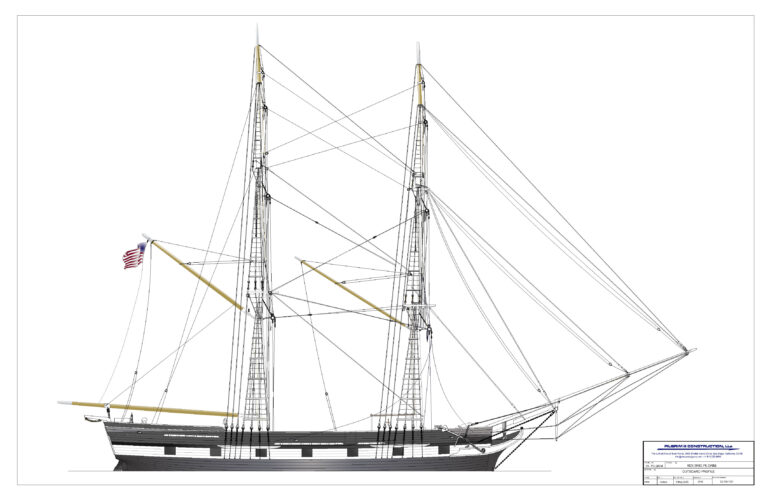
THE OUTBOARD PROFILE
A typical New England styled trading brig-rigged ship of 1825.
Sparred Length = 150 ft
Hull Length = 97 ft 9 in
Height of Foremast above water = 99 ft 9 in
Height of Mainmast above water = 104 ft 3 in